Rev Bras Oftalmol.2024;83:e0040
Corneal topographic alterations in women with endometriosis: data analysis in an ophthalmologic clinic

DOI: 10.37039/1982.8551.20240040
ABSTRACT
Objective:
To verify whether there are pathological dysfunctions in the cornea of patients with endometriosis.
Methods:
Case-control research with a quantitative approach that compared topographic and tomographic examinations of the cornea of patients with a laparoscopic diagnosis of endometriosis, without the use of hormonal medications, to the control group.
Results:
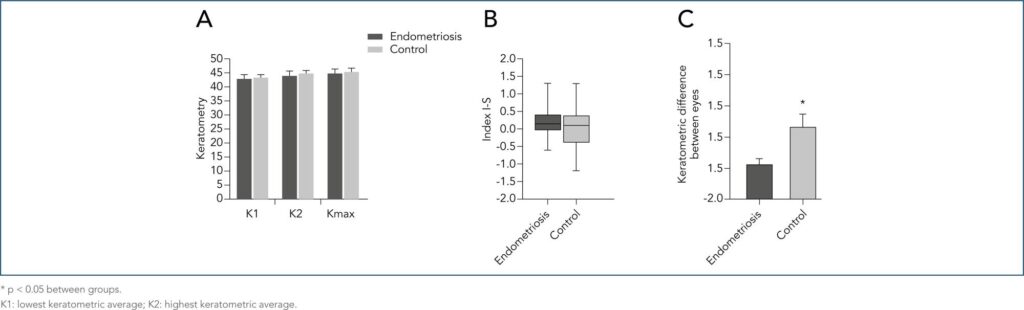
We analyzed 78 eyes, 34 from the endometriosis group and 44 from the control group. The loss of orthogonality between the axes of the corneal curvatures was more frequent in the group with endometriosis (p = 0.0744). The difference between the mean keratometric measurements of the two eyes was significantly greater in the control group (p = 0.0204). In the tomographic findings, the group with endometriosis presented higher means of posterior elevation compared to the control group (p = 0.0060).
Conclusion:
The results do not allow us to conclude that women with endometriosis have a higher risk of developing corneal ectasia, although the posterior elevation map demonstrated a greater posterior curvature of the cornea in this group, with a statistically significant difference. However, an isolated increase in the posterior elevation map does not have good diagnostic accuracy.
Keywords: Corneal diseases; Corneal topography; Endometriosis; Laparoscopy