Rev Bras Oftalmol.2025;84:e0030
Real-world evidence of the costs avoided over one year with the use of selective laser trabeculoplasty as a substitute therapy for eye drops

DOI: 10.37039/1982.8551.20250030
ABSTRACT
Objective:
To evaluate the impact of selective laser trabeculoplasty (SLT) on resource savings and medication costs.
Methods:
Retrospective study of patients with open-angle glaucoma (OAG) who underwent SLT as a replacement therapy for eye drops and were followed for up to 1 year. The ability to reduce intraocular pressure (IOP) and the amount of eye drops were evaluated, as well as the monthly cost of medications during the follow-up. The annual cost of medications was also calculated. The results obtained (SLT group) were compared with the theoretical cost of maintaining eye drops for the same period (medication group), assuming that the patients had not undergone SLT. A theoretical extrapolation of costs and their comparisons to the public health system (SUS) were also performed.
Results:
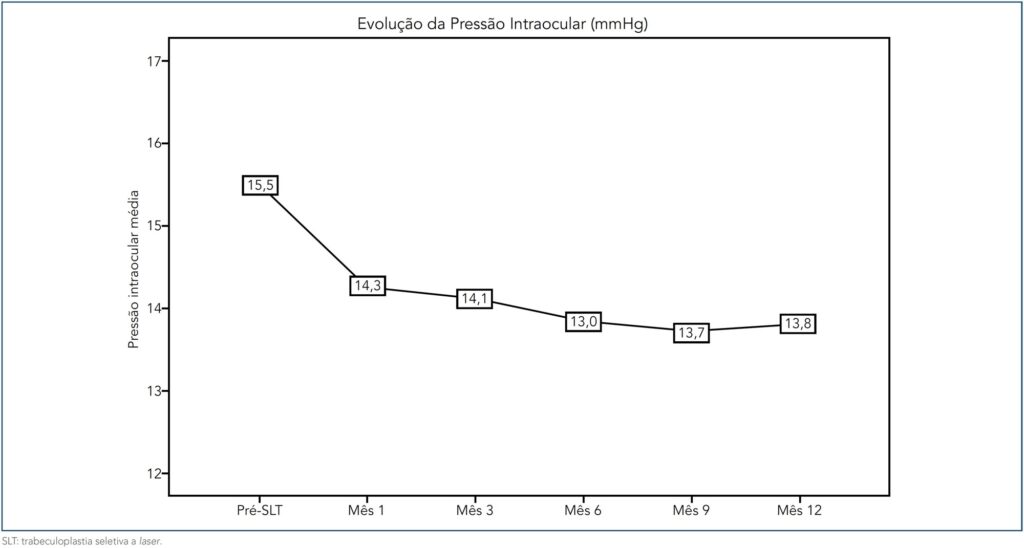
Mean IOP and the number of medications before SLT were 15.5 mmHg and 1.9, respectively (n=155). At the end of the follow-up, the mean IOP was 13.8 mmHg (p<0.001), and the number of medications was 0.6 (p<0.001). Before the laser, 57.8% of the eyes were using two or more medications, while at the end, 70.7% did not need any medication. The mean monthly cost of medication before SLT was R$331.14 in the supplementary health system and R$51.08 in the SUS. There was a significant reduction of more than 70% in the monthly cost. The annual cost in the SLT group was R$936.10 and R$158.03 in the supplementary health system and the SUS, respectively. The mean annual cost in the medication group was R$4,033.12 in the supplementary health system and R$625.90 in the SUS.
Conclusion:
The use of SLT as a replacement therapy for eye drops led to significant reductions in IOP, number of eye drops and costs associated with medications over a period of up to 1 year.