Rev Bras Oftalmol.2026;85:e0034
Agreement between Eyestar and IOLMaster700 in ocular biometric measurements in a Brazilian population

DOI: 10.37039/1982.8551.20260034
ABSTRACT
Objective:
To evaluate the agreement between the Eyestar900 and IOLMaster700 for biometric measurements and assess their interchangeability.
Methods:
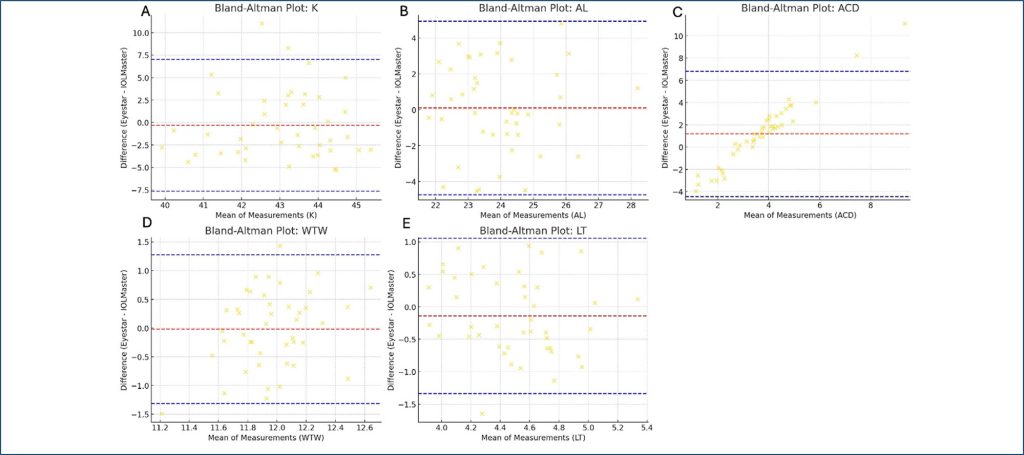
This retrospective study analyzed the following parameters: anterior keratometry, axial length, anterior chamber depth, white-to-white diameter, and lens thickness. Agreement was assessed using intraclass correlation coefficients, Bland-Altman plots, and scatter plots. A paired t-test was used to evaluate statistical differences.
Results:
A total of 43 eyes from 33 patients were analyzed. The mean differences were 0.03 D for keratometry, 0.08 mm for axial length, 0.48 mm for anterior chamber depth, 0.07 mm for white-to-white diameter, and 0.006 mm for lens thickness. Intraclass correlation coefficient values indicated excellent agreement for keratometry (0.990), axial length (1.000), white-to-white diameter (0.944), and lens thickness (0.994; p < 0.001), while anterior chamber depth showed lower agreement (intraclass correlation coefficients = −0.081, p = 0.599). Despite statistical significance, keratometry, axial length, white-to-white diameter, and lens thickness differences remained within clinically acceptable limits.
Conclusion:
The Eyestar900 and IOLMaster700 demonstrated excellent agreement in keratometry, axial length, white-to-white diameter, and lens thickness, supporting their interchangeability in routine clinical use. While anterior chamber depth measurements showed greater variability, their impact on clinical decisions may be minimized with careful interpretation. These findings reinforce the reliability of both devices for preoperative planning, with the potential to optimize surgical precision and intraocular lens selection.