Rev Bras Oftalmol.2025;84(Supl. 3):ex0006
Proliferative vitreoretinopathy: update in prevention and treatment

DOI: 10.37039/1982.8551.2025S3ex0006
ABSTRACT
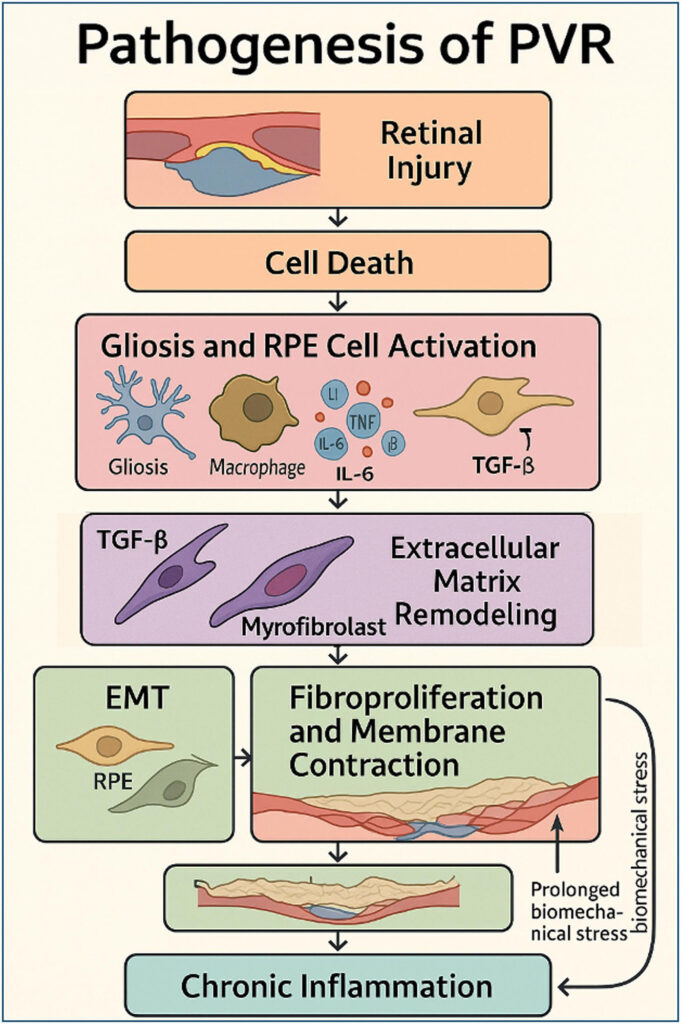
Proliferative vitreoretinopathy remains the leading cause of anatomical failure after rhegmatogenous retinal detachment repair, affecting 5 to 12% of primary detachment and up to 75% of redetachments. Although small-gauge vitrectomy, chromovitrectomy, high-definition intraoperative viewing systems and advanced preoperative imaging have revolutionized retinal surgery, the incidence of proliferative vitreoretinopathy has not decreased significantly over the past two decades. It represents a maladaptive wound-healing response in which inflammatory and fibrogenic pathways drive the formation of contractile preretinal, intraretinal, and subretinal membranes. This process typically occurs within 6 to 8 weeks after surgery, making timely prophylaxis critical. Surgical management of established proliferative vitreoretinopathy involves meticulous removal of the posterior hyaloid, residual vitreous and tractional epiretinal and subretinal membranes. The use of perfluorocarbon liquids (PFCL) and chandelier-assisted bimanual dissection improves visualization and membrane control. Brilliant blue dye enhances internal limiting membrane (ILM) identification, particularly when used under air to achieve negative staining. Small-gauge vitrectomy systems (23 to 27G) offer less invasive access, improved fluids and reduced postoperative inflammation. In complex cases, adjuvant techniques such as scleral buckling, retinectomy, and silicone oil tamponade are often required to achieve anatomical reattachment and prevent recurrence. Prophylactic therapies targeting the molecular drivers of proliferative vitreoretinopathy – such as corticosteroids, anti-inflammatory agents, anti-proliferative drugs, and biologics against cytokines, including tumor necrosis factor-alpha – are under investigation. Together, the integration of refined surgical technique, appropriate use of intraoperative adjuvants and emerging pharmacologic prophylaxis holds the potential to significantly improve anatomical and functional outcomes in patients with or at risk of proliferative vitreoretinopathy.