Rev Bras Oftalmol.2022;81:e0003
Subconjunctival adalimumab for treatment of dry eye disease in Sjögren’s syndrome

DOI: 10.37039/1982.8551.20220003
ABSTRACT
Objective
To describe the use of subconjuctival administration of the anti-tumor necrosis factor agent adalimumab for treatment of dry eye in patients with Sjögren’s syndrome, and to investigate conjunctival healing.
Methods
Prospective, nonrandomized, noncomparative interventional case series including consecutive patients with Sjögren’s syndrome and dry eye disease treated with subconjunctival adalimumab, who were refractory to conventional treatment. Patients with infectious ocular surface involvement or structural changes in the tear pathway or eyelids were excluded. Data recorded included age, sex, lissamine green staining pattern, Schirmer test results, intraocular pressure, conjunctival mobility, tear break up time and findings of biomicroscopic evaluation, following fluorescein dye instillation. The Ocular Surface Disease Index questionnaire validated for the Portuguese language was used for subjective assessment of patients.
Results
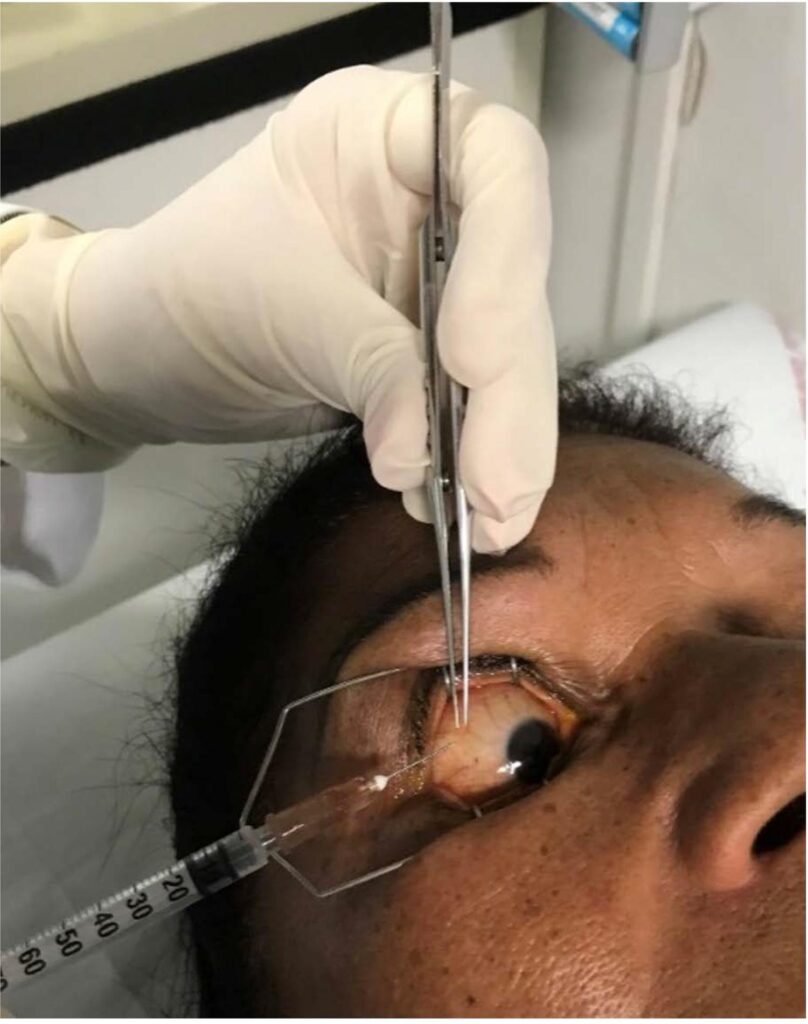
Eleven eyes of eight patients were studied. Mean patient age was 53±13.4 years. Patients were treated with subconjunctival injection of 0.03 mL of adalimumab and followed for 90 days thereafter. There were no statistically significant objective improvement (objective tests results; p>0.05) and no statistically significant changes in intraocular pressure (p=0.11). Questionnaire responses revealed a significant improvement in ocular symptoms (p=0.002).
Conclusion
Based on the Ocular Surface Disease Index questionnaire, subconjunctival administration of adalimumab improved dry eye symptoms. However, objective assessments failed to reveal statistically significant improvements.