Rev Bras Oftalmol.2026;85:e0046
Relationship between anterior segment optical coherence tomography and Scheimpflug-based tomography

DOI: 10.37039/1982.8551.20260046
ABSTRACT
Objective:
Early and accurate detection of corneal ectasias is essential for appropriate clinical management. The combined use of Pentacam and anterior segment OCT allows for a more comprehensive assessment of the morphological abnormalities associated with corneal ectasias, enabling earlier differentiation between normal and suspect cases. This study aims to investigate the relationship between OCT and Pentacam findings in the detection of corneal ectasias, analyzing their interdependence and clinical relevance.
Methods:
An analytical cross-sectional observational study based on data collected from medical records, in which 40 patients were selected to compose the sample.
Results:
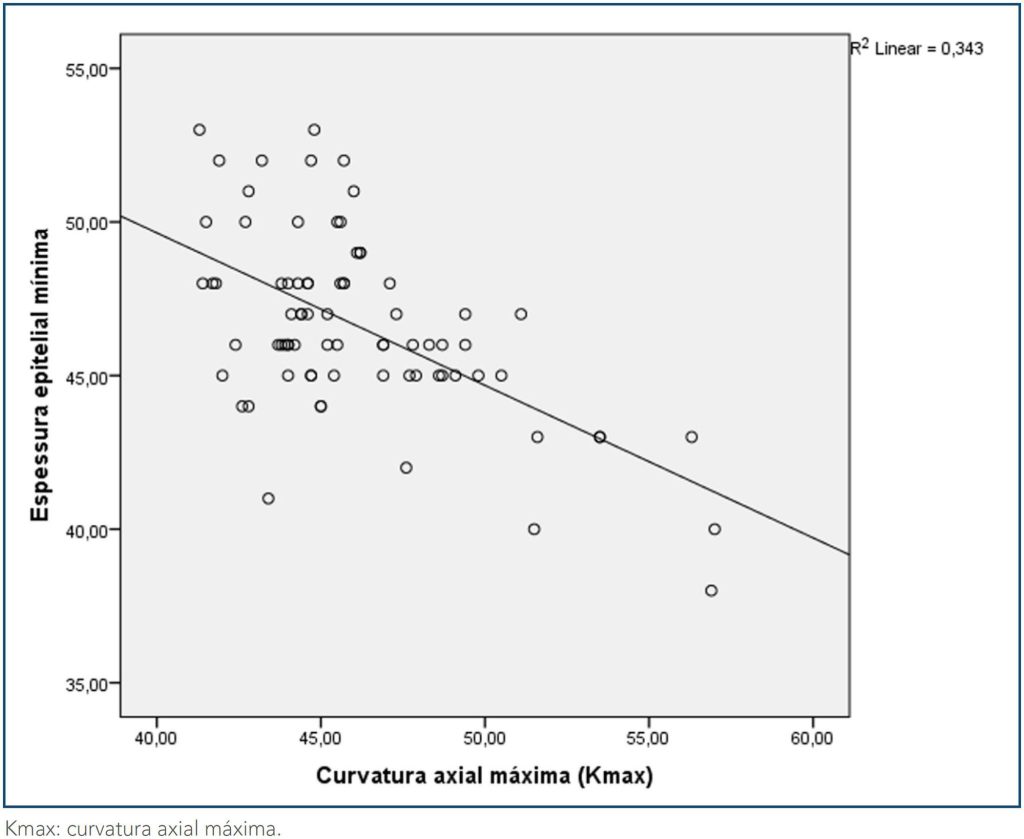
The minimum epithelial thickness of the cornea evaluated by OCT showed a moderate negative correlation with the maximum axial curvature (Kmax). A positive correlation was found between the difference in maximum and minimum epithelial thickness and the Belin-Ambrósio display (BAD-D). The average thinnest corneal thickness measured by OCT was 508.68 μm (±45.06), and 517.70 μm (±38.86) when measured by the Pentacam device.
Conclusion:
The study demonstrates the relationship between epithelial and tomographic changes in the early detection of corneal ectasias. Thus, this study emphasizes the importance of a multimodal approach in the evaluation of corneal ectasias for a more accurate diagnosis.