Rev Bras Oftalmol.2026;85:e0030
Application of Artificial Intelligence for prediction of congenital ophthalmologic malformations using perinatal data

DOI: 10.37039/1982.8551.20260030
ABSTRACT
Objective:
To evaluate whether an Artificial Intelligence model based on easily accessible perinatal variables can predict congenital ophthalmologic malformations, particularly those whose late detection may lead to preventable blindness.
Methods:
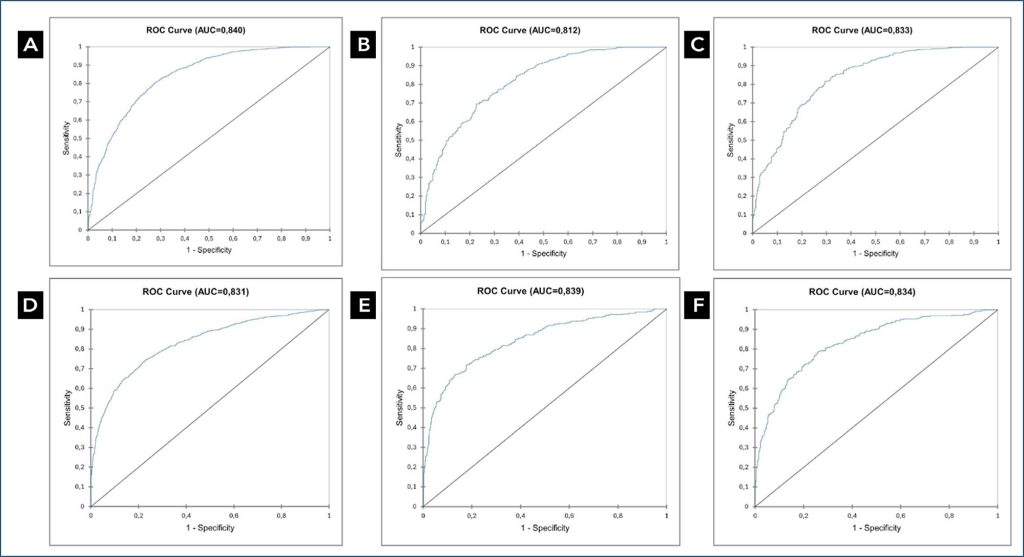
Retrospective diagnostic accuracy study using the DATASUS database. A total of 6,633 newborns in Brazil (2014 to 2022) were included, with 2,211 congenital ophthalmologic malformations (ICD-10 Q100-Q159) and 4,422 controls. Predictors comprised 14 maternal, obstetric, and neonatal factors; records with missing data were excluded. Logistic regression and support vector machine models were applied, assessing accuracy, sensitivity, specificity, and AUC. Subanalyses targeted clinically challenging congenital ophthalmologic malformations and those requiring early screening.
Results:
Logistic regression achieved 55.05% sensitivity, 91.32% specificity, and AUC 0.833; support vector machine yielded 47.82%, 93.01%, and 0.834, respectively. For hard-to-detect congenital ophthalmologic malformations, logistic regression obtained AUC 0.795, support vector machine 0.842. For screenable conditions, logistic regression reached AUC 0.790, support vector machine 0.761.
Conclusion:
AI models using perinatal data demonstrated good accuracy for congenital ophthalmologic malformation identification, supporting early screening in resource-limited settings.