Rev Bras Oftalmol.2026;85:e0109
Clinical, tomographic, and biometric differences between regular and irregular astigmatism in Iraq refractive surgery candidates: a cross-sectional study

DOI: 10.37039/1982.8551.20260109
ABSTRACT
Objective:
To compare visual acuity, corneal tomography, and ocular biometry between regular and irregular astigmatism in Iraqi refractive surgery candidates and to examine relationships among key parameters.
Methods:
Retrospective cross-sectional study of consecutive adults screened for refractive surgery at Ameer Moumnean Surgery Hospital (Al-Najaf, Iraq) between January and March 2026. Astigmatism was classified as regular (with-the-rule, against-the-rule, or oblique) or irregular based on tomographic/curvature-pattern assessment. Outcomes included uncorrected visual acuity (UCVA) and best-corrected visual acuity (BCVA) in logMAR, spherical equivalent (SE), keratometry (K1, K2, Kmax), central corneal thickness (CCT), intraocular pressure (IOP), and axial length (AL) measured using Pentacam HR and IOLMaster.
Results:
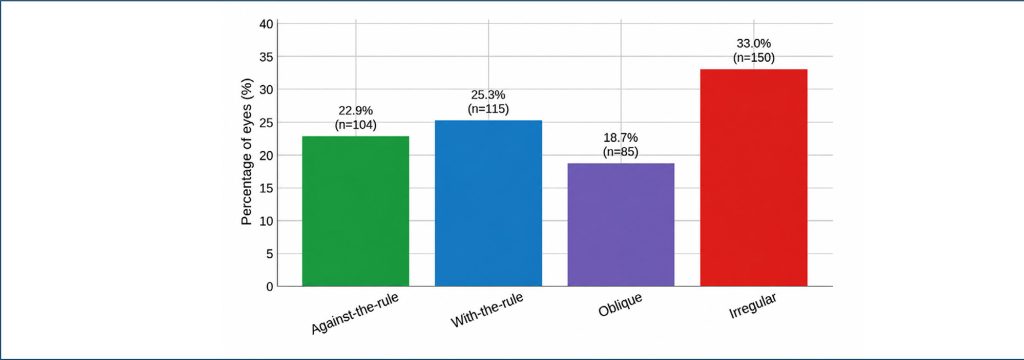
Of 454 eyes, 304 (67.0%) were classified as regular and 150 (33.0%) as irregular astigmatism. Compared with regular astigmatism, irregular astigmatism was associated with worse uncorrected visual acuity (0.58 ± 0.14 versus 0.34 ± 0.11 logMAR) and best-corrected visual acuity (0.39 ± 0.17 versus 0.07 ± 0.14 logMAR), more myopic spherical equivalent (−3.44 ± 2.45 versus −1.74 ± 2.05 D), steeper corneal curvature (Kmax 50.97 ± 2.87 versus 45.76 ± 1.57 D), thinner central corneal thickness (525.67 ± 34.85 versus 541.36 ± 31.28 μm), and longer AL (24.36 ± 0.91 versus 24.06 ± 0.83 mm) (all p < 0.001), whereas IOP did not differ (p = 0.881). Spherical equivalent showed a moderate inverse correlation with AL (Spearman ρ = −0.454; p < 0.001; R2 = 0.222), and central corneal thickness showed a weak inverse correlation with Kmax (ρ = −0.149; p = 0.0015; R2 = 0.035).
Conclusions:
In Iraqi refractive surgery candidates, irregular astigmatism was associated with substantially poorer visual acuity, markedly steeper corneal curvature, thinner corneas, and slightly longer axial length. These findings support comprehensive corneal tomography and biometry as part of refractive surgery screening.
Keywords: Astigmatism; Axial length, eye; Iraq; Refractive surgical procedures